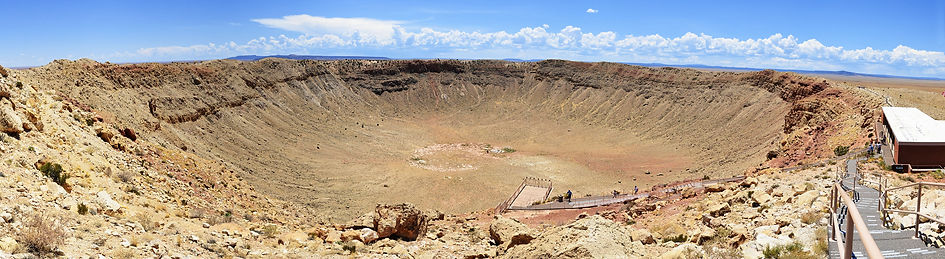
USGS Meteor Crater - Arizona
Formed approximately 50,000 years ago by the impact of a nickel-iron meteorite traveling nearly 30,000 miles per hour, Meteor Crater is one of the best-preserved impact sites on Earth. Located near Winslow, Arizona, the crater measures nearly a mile in diameter and more than 550 feet deep. Discovered by settlers in the 19th century, it was first thought to be volcanic in origin. Early scientists named it Coon Butte or Crater Mountain, but it was later recognized by geologist Daniel Barringer as the result of a meteorite impact—hence the alternate name, Barringer Crater. The site became a landmark for both scientific research and the study of planetary geology.
In 1983, Treeline Construction was contracted by the U.S. Geological Survey (USGS) to perform critical rehabilitation work on the #2 vertical mine shaft, a 165-foot-deep access shaft located within the crater’s research zone.
Treeline’s work included the structural stabilization and strengthening of the shaft, installation of a solar power system to support field operations, and improvements to ventilation and lighting—all designed to enhance safety and function in an extremely remote desert environment.
Because of the crater’s isolation and lack of road access to the work area, Treeline coordinated the helicopter delivery of all materials and equipment. Our crews self-performed all key trades, including carpentry, steelwork, electrical, ventilation, and rigging, executing the project with precision under challenging field conditions.
This project stands as one of Treeline’s earliest examples of remote-site construction and logistical innovation, setting the foundation for the company’s later expertise in delivering complex work in sensitive and difficult-to-access environments across the western United States.